The Hour Blog posted an exclusive excerpt from the book, leading up to tonight's interview on The Hour.
Cross had the audience laughing the entire time he was in the big red chair. Make sure you tune into The Hour for this interview.
Cross had the audience laughing the entire time he was in the big red chair. Make sure you tune into The Hour for this interview.You can't look at Canadian history for the past few decades without seeing the influence former Prime Minister Jean Chretien had on the country. Even before he lead the country, he played a huge role in defining Canada as it is today. I looked forward to reading his biography basically because I wanted to hear how he viewed what happened during his tenure as Prime Minister in particular the Quebec Referendum.
My Years as Prime Minister follows the 10 years that Chretien was Prime Minister of Canada.
It is a very interesting story, told in a very personable voice. I found myself captivated at certain points in the book, something that rarely happens to me in biographies. I enjoyed reading the stories that made the world leaders more personable than their politician personas generally let them be. I was particularly interested in his version of what happened with the whole Paul Martin situation. Beyond a being an engaging read, I love that this book captures 10 years of Canadian history.
Chretien visited The Hour after recovering from an unexpected heart bypass surgery that prevented an earlier visit to the show. I found the interview fascinating, so make sure you check out the full length, uncut interview on the website
Thirty-five years ago, a young economics professor at a university in Bangladesh was struck by the disconnect between the theories he was teaching in class and the reality of the famine outside. So, determined to help, Mohammed Yunus left the classroom for a village, and discovered that just $27 would free dozens of artisans, vendors, and rickshaw pullers from debt. Offering himself as a guarantor, he withdrew a loan, paid off their debts, and founded Grameen Bank -- a bank that has disbursed over $8 billion, lifting millions of people from poverty with microloans. Mohammed Yunus was just trying to help a village, but he somehow managed to change the world.The concept of microcredit is simple: loan a small amount of cash to start up their own business, let them make some money and then pay back the loan within a year. And it worked. But now there's another layer to add to this concept: social business.
I've followed Jamie Oliver's tv career since it launched with The Naked Chef in the late nineties. It's been amazing to watch how he's taken his philosophy regarding food and created an empire of good food and eating well. One of his recent books, Cook with Jamie continues to build on his philosophy of maximizing the character and flavour of food.
I'll admit it... I devour cookbooks. I love to see how people play with traditional recipes and put their own unique stamp on food. I've read all of Oliver's books because I enjoy the "voice" he writes with and how he puts recipes together. I always find myself bookmarking half of the book for future dinner parties. I could honestly see myself cooking my way through Cook with Jamie in a similar fashion to the character Julie in the movie Julie and Julia.
Another thing I liked about this book is that it is designed to help people who may not be well-versed in the kitchen accomplish more than just toast and boiling water. I'm always on the look out for cookbooks that would suit my friends who are not so comfortable in the kitchen, and I think this book offers readers a good basic look at preparing some ingredients that might scare novices in the kitchen, such as squid, mayonnaise fresh pasta or cake that doesn't come from a box.
The photography is amazing and makes the book, which weighs in at over 400 pages) a treat to flip through. There are a few recipes in the book that have become "go to" recipes in my kitchen, such as the recipe for the lightest potato gnocchi, the mushroom risotto, the roasted cauliflower with cumin, coriander and almonds and Oliver's nan's lemon drizzle cake.
If you're looking for an addition to your cookbook collection or just like drooling over food photography, check out Cooking with Jamie. When Jamie Oliver appeared on The Hour he cooked George up a little gem of a dish in the office kitchen... check out his "masterpiece". Then once you've regained you equilibrium, check out what happened when he sat down in the red chair to chat with George.
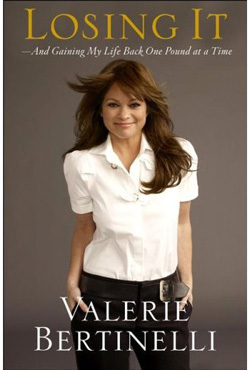
I'll be honest, this book was never really on my list to read. I thought the interview on The Hour was interesting, but not something I wanted to pursue beyond that one segment. However, I was at my local library last week and found "Losing It: And Gaining My Life Back One Pound At A Time" by Valerie Bertinelli staring at me from the featured book display. Since I was on Summer Vacation at the time, I was looking for a different kind of read so I picked it up.
I was surprised, it was a good read. It's an interesting journey through Bertinelli's life, from her first encounter with acting to the night her son started touring with her ex-husband as Van Halen's new bassist. I liked that this book didn't glamourize her issues unlike some celebrity biographies I've read in the past. I liked that she was seemingly frank about how her life felt totally different than how it was perceived by the outsiders.
I'm not sure how I feel about using the whole weight loss thing to tie the book together, but it's used as her catalyst to happiness. I did come away from the book with the notion that we all have a story to tell, and on some level everyone's story is similar.
Make sure you check out Valerie Bertinelli's 2008 interview on The Hour.
One of the best parts of the Mercer Report are the rants. So I was tickled when Mercer released a book filled with some of his best rants. I've read it a few times since its release, so much so it's become one of those books that I pick up and reread when I can't get into anything new. Everyone rants, we all come across people or events that just set us off, so hearing Mercer rant is kind of an extension of what everyone is thinking but may not want to openly admit.
This book of rants is an interesting glimpse into the affairs that captivated Canada (or held Canada hostage) over the past few years. From election after election after election, to Conrad Black's antics, to the latest Parliamentary hijinks (or hijacks, depending on how you look at it) to just plain weird Canadian behaviour (like Torontonians and winter weather), Mercer has somehow captured the essence of what Canada is. Speaking of Conrad Black, one of my all time favourite rants comes from the time is when Conrad Black wanted his citizenship back.
The first edition of the book came out in 2007 but was updated for the 2008 paperback release.
Mercer's been on The Hour a few times over the years: Book Interview, Interview - Part One, Interview - Part Two, Mercer at the Book Stand. Make sure you check them out.
‘That was me, the guy begging money for a bottle of wine and a fifty-cent bed in a flophouse. I was thirty years away from being named an Officer of the Order of Canada, twenty years away from marriage and fatherhood, ten years away from earning my first million dollars, and a week away from deciding that I must change or die.”Having watched the interview on The Hour, I knew that O’Dea’s story was intense, but I wasn’t totally prepared for just how dark parts of his story really was. The cliche term “rags to riches” is not so cliche in this story; O’Dea really went from wearing rags and living on the street to the life of the elite.
Written after his near death experience in Chile, Things I Overheard While Talking to Myself chronicles Alda's thoughts on a variety of subjects through many of the speeches he's given over the years at commencements and other life events. He opens the book with his daughter's commencement and from there weaves a tale that just enjoys the twists and turns that life brings.
It really is a book of questions and answers. He questions the choices he made and the choices he didn't make. It's as if Alda sees life as a maze of choices, if I go left this will happen but if I go right will I hit a dead end or is it the way through? In some ways his ponderings made me ponder some of the questions in my life and whether or not it's worthwhile to go in whatever direction I'm thinking of at the time. I like his writing "voice", it's almost as if I can hear him narrating the book in my head.
I would suggest reading his biography Never Have Your Dog Stuffed before reading this book, because I think it will help fill in some of the gaps where it felt like Alda assumed we knew the back story of his life at a particular moment in time.
Make sure you check out Alan Alda's interview on The Hour in November 2007, he gives a very good foundation for this book. Also check out an extra clip from the interview on More with Alan Alda.
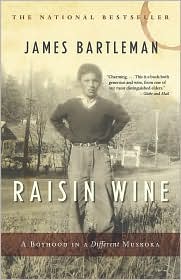
Raisin Wine: A Boyhood in a Different Muskoka is the story of James Bartleman, the former Lieutenant General of Ontario. I was intrigued by this book, as I am by most biographies, so I sailed right in after finding it on display at the library with an assortment of other Canadiana books on a table preparing patrons for Canada Day.
What I expected was the story of James Bartleman and how he eventually made his way to the Ontario Lieutenant Govenor's chair but what I didn't expect is that the book would be written as a novel, in a third person omniscient voice and with few proper names used in the book. The main character was refered to as "the boy, while other characters were referred to as "the boy's mother/father/brother/sister". This was not your average run of the mill biography, it spans only a few years in the fifties, though the years covered were probably the most formative years of anyone's life, when children were just discovering the teen years and what lies beyond the family circle. It's always interesting to read how someone who attained Bartleman's stature later in life, was obsessed with ice cream and comics from the general store or how he helped the family's income by collecting scrapmetal and selling fish to his neighbours as a child.
This book also paints an interesting picture of Muskoka as it grew into the tourist haven it is today. Focussed around Port Carling, the book speaks of how the region grew from the disappointment of the first settlers and the displacement of the First Nations to the growth of cottages and summer homes owned by the people from the "South" (Toronto). With the conditions of reserves currently in the news due to the swine flu outbreaks, I found it rather depressing to read that nothing much has changed in that regard since the time frame of the book, that some First Nation reserves still struggle for basic infrastructure and needs, while battling the same demons such as substance abuse.
As soon as I finished reading this book, I recommended it to a friend who lives in Muskoka. It is a compelling read, of a little boy growing into a teenager and the dynamics that shaped who he is today.
Please check out James Bartleman's apperance on The Hour. Like the book, this interview is very compelling.
The biggest reason travel writing is dull, as Queenan correctly pointed out, is that most of it is devoid of anything approaching an authentic point of view. On those rare occasions when travel writers are allowed to express an actual opinion, it must be a completely harmless one that's also shared by the travel industry at large. These are usually offered as hard-hitting commentaries describing how “quaint” a hotel room is, how “mind-blowing” a nature park is, or how “mouthwatering” a chef's specialty is. Everything is superlative. Like being a sports fan, one of the best things about being a traveler is complaining about the parts you don't like—hating the Dallas Cowboys not only doesn't make me any less a football fan, it probably makes me a more avid one. This is a concept the travel industry has never embraced.